
Diversity in Wild Cotton Populations
Background
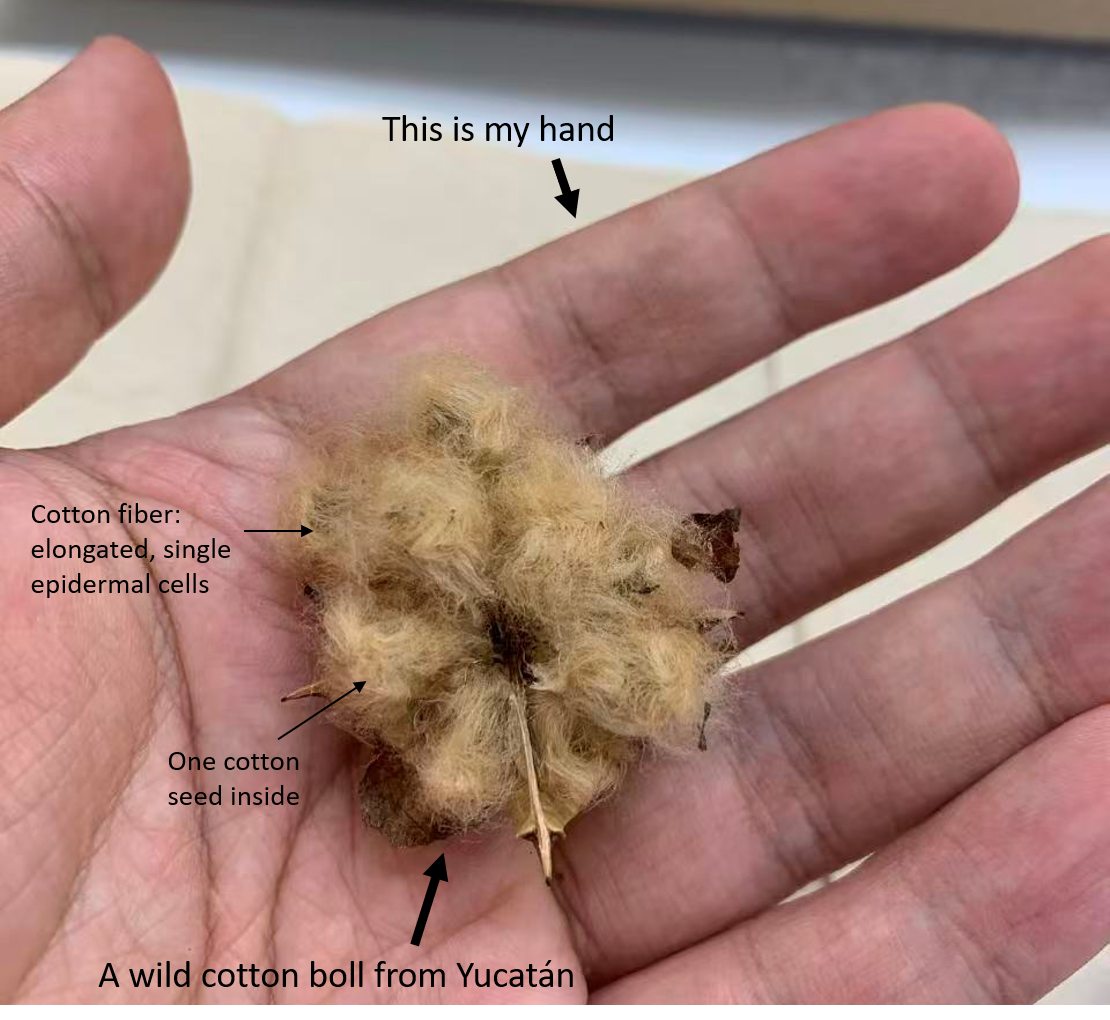
Wild cotton today is a relatively uncommon plant, this rarity resulting from both intentional human activities, including habitat destruction and intentional eradication as a putative reservoir of boll weevil, and unintentional processes such as increased competition from other plants in fire and flood-controlled habitats and natural population turnover due to storms and natural succession. Truly wild cotton has a large aggregate but locally sporadic natural distribution in the drier coastal areas of the American tropics and subtropics, including areas of the northern Yucatan Peninsula, SW Florida, SW Puerto Rico, and a number of additional islands throughout the Caribbean. Initial domestication is thought to have occurred perhaps 4,000 years ago in the northern Yucatan, with subsequent spread as a semi-domesticated plant throughout both its natural range and far beyond to its present status as the world’s most important fiber plant. Accompanying the many millennia of human-mediated dispersal and plant improvement was a complicated history of repeated escape of semi-domesticates back into natural settings, as well as hybridization with a second, independently domesticated cotton, Gossypium barbadense. These reestablished or naturalized semi-wild cottons are often difficult to distinguish from the rarer, truly wild populations. Thus, understanding the genomic diversity of wild cotton is challenging. It also is important for our appreciation of the true scope of the natural gene pool, the portion of it that was captured by the domestication process, and by implication, the total diversity which was never incorporated into the crop plant and thus represents a precious natural gene pool reservoir.
Aims
- Can population genetic analyses be used to identify relationships between domesticated and wild cotton?
- How much genetic diversity exists in wild Gossypium hirsutum, and how is it distributed within and among populations?
- Can we identify the domestication and diversity center of wild cotton?
Output
Ning, W., Rogers, K. M., Hsu, C. Y., Magbanua, Z. V., Pechanova, O., Arick, M. A., … & Wendel, J. F. (2024). Origin and diversity of the wild cottons (Gossypium hirsutum) of Mound Key, Florida. Scientific Reports, 14(1), 14046. Behind the Paper